Search This Blog

Sunday, March 10, 2024

Thoughts on Barb Wire

    On Criterion, they are showing a selection of Razzie-winning movies, movies that got voted as the worst movies, and I watched Barb Wire from 1996, the Pamela Anderson dystopian superhero movie where she’s in a tight bustier, talks in a bored, annoyed monotone the entire movie, and the plot shamelessly rips off Casablanca, where her ex-boyfriend is married to a woman that is a fugitive, and they are trying to escape the Nazi-like government during the Second American Civil War in 2017.

    Pam Anderson is Barbara, aka Barb Wire (and it kept making me chuckle anytime someone calls her “Miss Wire), who runs her warehouse club where an industrial band does a cover of Patti Smith’s “Dancing Barefoot,” and the totalitarian government does retinal scans on people to check their identity and does weird electroshock torture on people that only just seems to turn them on.
    It’s easy to just crap on the movie, and I can’t really defend it as good, but some stuff I genuinely liked. I liked Jack Noseworthy as her brother who was blinded in the war, he was fun with a sarcastic sense of humor, and I cared more about their brother-sister relationship than her past relationship with her blank slate of an ex-boyfriend. The movie is set in 2017, but clearly takes more of the 90s industrial look of raves and hard rock and bondage clothes. Clint Howard is fun to watch because he knows when he’s in B-movies and doesn’t phone it in, he just has fun, especially in this scene. And in the action finale, Pam Anderson’s stunt double clearly was putting in a lot of work doing fight scenes on construction equipment in tight clothing, and it was more of a creative stunt scene to watch.
    And from reading the IMDB trivia, the whole running joke with her getting pissed at being called Babe was from the original comics: “The entire "Don't call me, Babe" leitmotif of Barb Wire comes from the original advertising for the Barb Wire Dark Horse comic book, in which she said those words to differentiate herself from a buxom, slightly airy comic book heroine named Babe by John Byrne.”
    So this was dumb, but not that bad to watch, just kind of schlocky and an attempt for Pam Anderson to star in a big-budget movie, since her previous movies were mostly forgettable straight to video erotic thrillers. She did star in the fun campy TV series V.I.P. after this, which was much more tailored for her style of self-aware comedic skills.


Sunday, March 3, 2024

Thoughts on Cruising

     On Criterion, I watched the 1980 film Cruising, written and directed by William Friedkin, based on the novel by Gerald Walker, and starring Al Pacino, Paul Sorvino, and Karen Allen. The film is notorious for having been protested by the LGBTQ+ community, because it is about a cop named Steve Burns (Pacino) on an undercover assignment to go into gay leather bars in the West Village and Christopher Street area to find a serial killer that has been targeting gay men, and using him as bait because he matches the slim, dark-haired look of his victims. The film depicts gay men as victims, murderers, and into the S&M scene, and given that so little of mainstream Hollywood at the time would depict queer characters in a more well-rounded way, it's understandable that the gay community would be against it. The film is largely seen through the straight cisgender lens, of the straight cop being internally weirded out by seeing public gay sex and kinky club scenes, and whenever he comes home and has sex with his girlfriend (Allen), who is unaware of the nature of his assignment, it's like he's trying to prove his straightness and quickly shed his gay cover identity.

    It's an interesting movie, and outside of the straight male lens of the film, it's unique to see a movie capture the sense of the gay leather bar scene of downtown NYC, trying to show as much as they could of the sexuality without getting an X rating, and showing a glimpse of the gay scene before the AIDS crisis would take over and change the whole cruising scene afterwards. The film incorporates elements of the giallo horror genre, and Friedkin slipped in quick cuts from gay pornography during the film's first murder scene, that can be seen when the film is slowed down, a la Tyler Durden's projector trick in Fight Club.


    Friedkin had stated that he was originally interested in Richard Gere for the lead, and that while he was satisfied with Pacino's performance in retrospect, he felt like Pacino was uncomfortable with the overtly queer scenes, while Pacino has said that he didn't know what Friedkin wanted from him as an actor, and the film is left open-ended with a finale with his character that doesn't seem to make a lot of sense, and could be interpreted a couple of ways. I do agree that I can see Gere fitting in, as he would have a rough trade, hustler look circa 1980, and would blend in more in the scene than Pacino does, whose eyes often make him look more nervous and out of place.
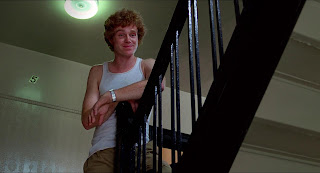
    I liked the supporting performances of Don Scardino as a struggling gay playwright who is Burns' neighbor, more of a shy, quiet guy in contrast to the more sexually assertive characters in the cruising scene, and James Remar as the playwright's boyfriend, who only appears in one scene but stands out with a lot of screen presence and boldness. I was surprised to see Ed O'Neill in an early role as a cop, as well as William Russ as the killer's friend, Mike Starr as a cop, Maniac director Joe Spinell as a cop, and Powers Boothe as a salesman.

    I liked seeing Karen Allen, but felt her character was very one-dimensional and underused. She's just cast as the worried girlfriend, either getting pounded in a sex scene, or saying cliched lines like "Are you still attracted to me?" or "I feel like I don't know you anymore," stuff that just makes her character look boring and shafted off to the side. It's a thankless role, and luckily she would get a much meatier part in 1981's Raiders of the Lost Ark as Marion, the hard-drinking adventurer by Indiana Jones' side.

    The gay community of the West Village circa 1979 would protest the film by purposely disrupting filming with pointing mirrors to mess up lighting shots, blasting whistles and air horns, and playing loud music. The audio would have to be overdubbed to remove the distractions from people off-camera. Also, gay-owned businesses wouldn't allow filming on their premises, and real leather bars wouldn't allow their places to be used, so the film would make up a club but use real patrons from gay bars as extras for authenticity. 

    The film is accurate in depicting police brutality and the targeting of queer people by the cops, and how corrupt and awful it is. The film has an early scene with two cops (Spinell and Starr) in their car harassing two transwomen sex workers, and making them get in their car and perform sex acts on them. Then one of the women, when she tries to tell a cop (Sorvino) what happened later, is not believed and ignored. The film also has an interrogation scene where, while Burns is undercover and had been arrested with a potential suspect, are both beaten by a 6'5 man in a jockstrap, who just seemingly is on retainer by the police for this one task, and the suspect, a young gay man who looks more like a kid, is humiliated by the police, and is obviously not the killer. The police later dismiss a murder of a gay man as a "lover's quarrel." The film is honest about the police being abusive and corrupt, and no punishment comes to them, as unfortunately would be likely in real life.

    It's not the kind of movie I would watch again, and it is limited by being a movie about gay life through the eyes of straight men, but I felt like it was an interesting cop thriller to watch that felt very much of its time.

Sunday, February 25, 2024

Thoughts on All of Us Strangers


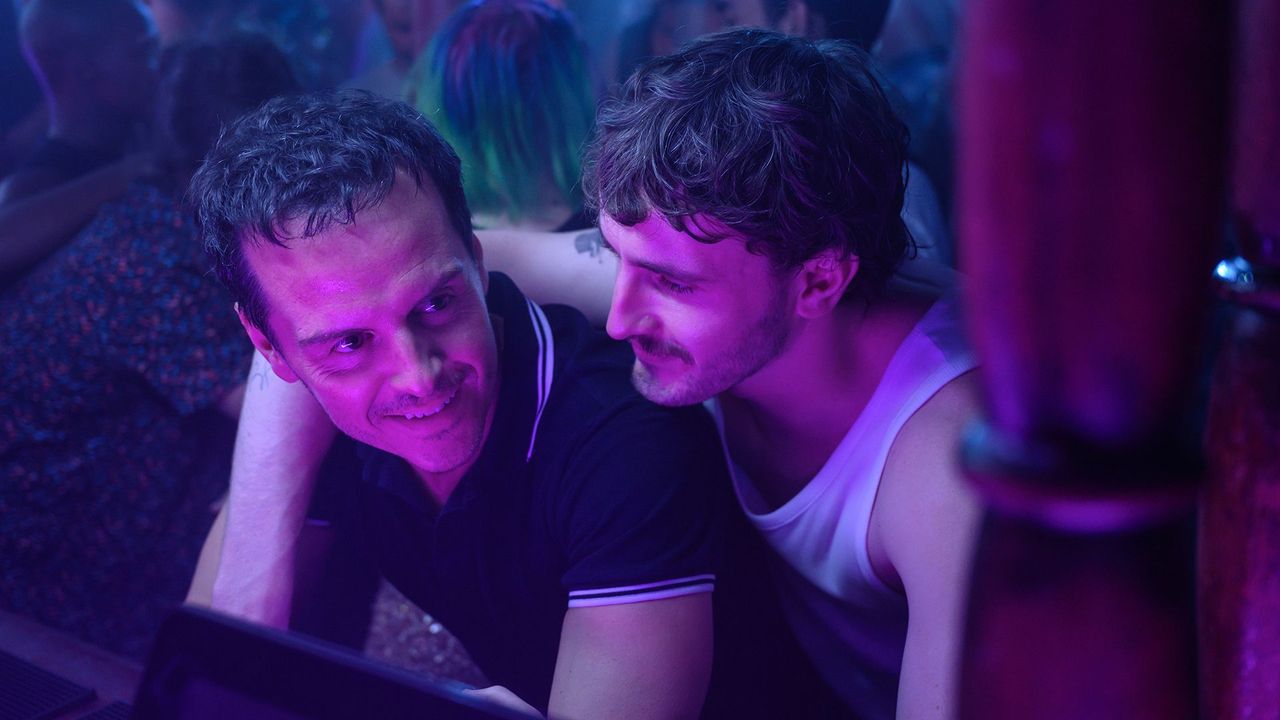
    On Hulu, I watched the 2023 British film All of Us Strangers, written and directed by Andrew Haigh, based on the 1987 novel Strangers by Taichi Yamada. It starred Andrew Scott, Paul Mescal, Jamie Bell, and Claire Foy. It's described as a romantic fantasy film, which makes sense, but it has a lot to do with grief and loneliness and isolated feelings from being gay and not feeling one's family's acceptance. I really loved this film and felt very emotionally affected by it.


  Adam (Scott) lives in a high-rise tower building in London, in a large apartment where he feels isolated and lonely. A gay man, he's largely led a solitary life, afraid of letting people in emotionally, and affected deeply by the deaths of his parents in a car accident when he was twelve years old in the 1980s. His friends have gotten married, had kids, and moved out to the suburbs, and his large windows overlook London, but he feels further from it. By chance, he meets his neighbor Harry (Mescal), who is also a gay man living alone, and over time, they tentatively begin a relationship, though Adam keeps emotionally holding back, while Harry, feeling shut out and ignored by his family because he's not in a heteronormative lifestyle, wants closeness. It's a very touching relationship portrayed with actors with a lot of tenderness and sensitivity, and I really thought Scott and Mescal had great chemistry together, I could really feel the burgeoning love story between them.

    Adam, missing his childhood, takes a trip back to his hometown, and goes to the now-empty home where he grew up. Only now, he meets his parents, who are either ghosts or in his imagination, still their young selves in 1980s fashions, immortalized as they were the day they died over 30 years earlier. Portrayed by Jamie Bell and Claire Foy, both deliver fantastic performances of a small-town British couple who are nice and well-meaning, but, when Adam comes out to them, they are polite but have ingrained homophobia, as a product of their time and limited experiences with queer people. His mother is shocked that gay people can get married and no longer have to live in fear of the AIDS virus, and his father admits that he had harbored some toxic masculinity towards queerness. But while they initially show some dated reactions, they do become accepting of Adam, just wanting him to be happy, and pushing him to develop a relationship with Harry, to not let himself be isolated anymore.

    Adam describes his feelings like a knot tightening in his chest, and it's an apt feeling of feeling anxiety and being hard on oneself, holding onto his grief, and not wanting to let others in or be emotionally intimate with others, but it only hurts oneself in the end, not letting himself move on from his trauma and allowing himself to be happy in his life. He is affected also by having grown up during the AIDS crisis while Harry is a lot younger, without the same sexual fear.

    Music of the 1980s plays a major role in this film, with a lot of queer pop acts like The Pet Shop Boys and Frankie Goes to Hollywood as recurring motifs, and Jennifer Rush's "The Power of Love." Music is nostalgic, bringing Adam back to his childhood with his parents, with the Pet Shop Boys' "You Were Always on My Mind" playing in a poignant scene with his mother while decorating the Christmas tree, a deeply emotional moment perfectly played by Foy. And Frankie Goes to Hollywood's different song also titled "The Power of Love" has lyrics that are repeated throughout the film, spoken by Adam and Harry, like "I'll protect you from the hooded claw, keep the vampires at your door," an all-consuming, powerful love that Adam wants but is afraid to accept.

    It's an incredible film, and I was very touched by it, drawn into this very intimate world with only four principal characters, and though I've already made my "Best of 2023" list, I would include this as one of the best films of last year.

Thoughts on the 2023 Oscar-Nominated Short Films

I watched several of the Oscar nominated shorts, the ones I could find for free or on streaming sites I’m already on.

* I’m taking a break from Netflix, so I didn’t see the short film starring David Oyelowo called The After, that got nominated as well.
1. Nai Nai and Wai Po - documentary directed by Sean Wang (on Hulu): a sweet documentary about his Taiwanese grandmas who live together like sisters, are in their 80s and 90s, and are cute and funny, keeping active to stave off any injuries if they fall, and know the end of their lives is near and being mentally prepared for it. This was produced by Disney, and nice to watch.
2. The Wonderful World of Henry Sugar - live action directed by Wes Anderson (on Netflix): Wes Anderson made about four-five short film adaptations of Roald Dahl stories, and this one, featuring Benedict Cumberbatch and Ben Kingsley, was really good to watch, where the characters narrated the story, including the actions, and turn to talk to the audience a lot, like they’re in a play. Dev Patel was really good as well.
3. Ninety-Five Senses - animated directed by Jerusha and Jared Hess (on Documentary Plus for free): Narrated by Tim Blake Nelson, it’s the story of an old man meditating on his five senses as his life is coming to an end, to be executed for murder. I liked Nelson’s narration, and the animation was nice, but I wasn’t too interested in the character or his story. His murder story was him trying to get petty revenge and accidentally killing people, and I couldn’t feel sorry for him.
4. The Barber of Little Rock - documentary directed by John Hoffman and Christine Turner (on the New Yorker website): a really good documentary on economic inequality with poor Black citizens in Little Rock, Arkansas, and a Black-owned loan program that gives emergency loan grants to people and helps them start their businesses, pay their rent while they find a new place to live, and find jobs and get coverage for their medical expenses. The film follows Arlo Washington, a young man who started the loan program and a barbershop school to train people and provide job opportunities. It talks about Black people wanting to build wealth and own houses and have a stake that is theirs, and to close the racial wealth gap.
5. The Last Repair Shop - documentary directed by Ben Proudfoot and Kris Powers (on Hulu): a really good documentary on an L.A. warehouse where craftspeople and technicians work on repairing musical instruments that children use in school, and the movie features interesting backstories of the technicians, like immigrants escaping war and hardship to find a place in the U.S., finding job opportunities with the instruments and skills in repairing them, and clips of the kids talking about what the music means to them. It was interesting and really nice to watch.
6. Island in Between - documentary directed by S. Leo Chiang (on the New York Times website): This was about Chiang’s experiences growing up on the Taiwanese islands of Kimmen, just a few miles from mainland China, and reflecting on his relationships with Taiwan, China, and the United States, comparing it to a three-way parental relationship. I thought it was okay, and interesting to learn more about Taiwanese people talking about Chinese colonialism and seeing their planes fly over them, and the ferry to China being closed, and other issues. I wasn’t as into it as some of the other films, but it was decent.

Monday, February 19, 2024

Thoughts on Drugstore Cowboy

    I rewatched Drugstore Cowboy on Criterion, Gus Van Sant’s 1989 indie breakthrough about a group of addicts robbing pharmacies in 1971 Portland, Oregon, just scraping by on drug deals and highs. Matt Dillon, Kelly Lynch, James LeGros, and Heather Graham play the crew, and this movie definitely feels like a precursor to the 1990s indie movie boom, it feels more like a 90s movie than an 80s movie. It’s a weirdly comfortable movie to watch despite the story of desperate addicts, likely because they feel more like scrappy losers in a darkly comic story.

    Matt Dillon is really good at playing losers and dumb guys, like guys who peaked in high school as handsome popular guys, then didn’t have the brains to go further in life beyond getting external validation from popularity. He transcended well from being a Brat Pack-era teen idol to a talented actor not afraid to poke fun at himself.
    I like how others react to the group, like Dillon’s mom hiding their valuables when they come over, or this scene, where Dillon is in rehab and has pretty much nothing to his name, no identity or job history, essentially being a vagrant with his only paper trail being his priors.


Thoughts on We Own the Night

    Last night I watched James Gray’s 2007 crime film We Own the Night, where in 1988 Brooklyn, Joaquin Phoenix plays a club owner named Bobby who turns a blind eye to drug dealing going on in his club, getting wrapped up in casual drug use, until his cop family (Robert DuVall and Mark Wahlberg) are working vice and street crimes and targeting the drug crime ring operating at the club. Then Bobby is torn between his fractured relationships with his cop father and brother, and being complicit with cocaine trafficking coming into his club and inviting more violence in.

    It’s a pretty good movie, engaging to watch, and while Mark Wahlberg feels like he can play a cop in his sleep, Joaquin Phoenix is good in this as a guy wanting to live the party life with no consequences, and ends up feeling sick and awful when his complacency does come back to bite him.
    I forgot how famous Eva Mendes was in the 2000s, since she’s long retired from acting (save for a 2021 voice cameo on Bluey), and she really had this 1960s glamour look that worked so well for her. She plays Amara, the partying girlfriend of Bobby, but this scene shows her dealing with violence hitting too close to home, getting too real for her, and trying to convince her boyfriend not to take more risks. It’s a really good scene between her and Phoenix.


Sunday, February 11, 2024

Thoughts on Gothic

    On Criterion yesterday I watched Gothic, a 1986 film directed by Ken Russell, a fictionalized take on a stormy night in the 1810s where literary friends Lord Byron (Gabriel Byrne), Percy Shelley (Julian Sands), Mary Shelley (Natasha Richardson), and John William Polidori (Timothy Spall) entertained each other by telling horror stories, from which came Shelley’s Frankenstein novel and Polidori’s short story “The Vampyre.” Because this is directed by Ken Russell, the movie is full of erotica and horror and weird visuals, and is a good mix of over the top Gothic horror with real-life literary figures.

    It’s a little bittersweet watching Natasha Richardson and Julian Sands together, as both died in tragic ways, Sands only this past year. Sands was good at both playing villains (in Warlock), and playing Percy Shelley and going mad in this horror house that has a dungeon with rats in it. And Natasha Richardson had a romantic beauty to her that feels very Shakespearean, and had a commanding queenly feel to her presence. The movie includes graphic images of her having visions of her miscarriage, so a content warning there.
    One of my favorite effects in this is NSFW, but it’s when Percy hallucinates seeing eyes in breasts, so when he sees the bare breasts of his sister in-law, the effects place eyes where her areolas are, and it’s a creepy but good effect.
    I liked how over the top this was, and how it made me think of the 1994 film Mary Shelley’s Frankenstein, where Kenneth Branagh’s Victor Frankenstein has a similar frantic, mad vibe that Julian Sands as Percy Shelley did, and this film makes clear allusions to the creation of Frankenstein, with Mary wanting to resurrect her dead baby, and Shelley saying “It’s alive” in one scene.
    So this was interesting to watch as a British horror film that could go more crazier than the Hammer horror films due to more lax standards on erotica in film, so Ken Russell could go nuts with it.