My blog where I write about films I enjoy and post interviews I've done with actors and filmmakers. I am a sci-fi fan, an action film nerd, and into both arthouse films and B-movie schlock.
I saw two movies at BAM yesterday as part of their film festival BAMCinemaFest. The first was Dope, directed by Rick Famuyiwa which, is showing in both indie and mainstream theaters. Dope centered on a teenage black male nerd named Malcolm (Shameik Moore) who was a 90's hip-hop head in present-day Inglewood, CA, and dressed like a cross between Dwayne Wayne and the Fresh Prince. He has nerdy friends and works to maintain his identity while mingling with local street folks. He gets involved in a drug-dealing scheme through a convoluted set of circumstances, and uses his nerdy image as a cover to avoid detection.
I was mixed on it, liking the characters and style, but not so much the story. I liked the throwback hip-hop soundtrack; the heroes being black nerds; the story being influenced by Superbad and Friday; an awesome shout-out to the underrated coming-of-age movie The Wood; a funny performance by model Chanel Iman as a cokehead rich girl; Zoe Kravitz' performance as a young woman studying for her G.E.D. and dealing with both her drug dealing friends and the nerd protagonist, caught between wanting to be seen as more than just a sexy hookup but not leaving her past behind; and the nerds gaming the drug dealing system through their tech and science skills. The characters were complex and I liked the depth that was given to their personalities and attitudes. However, I didn't like the slapstick, silly parts; the gratuitous female nudity, the heavy-handed, melodramatic final monologue that was an anvil spelling out everything that was already shown in the film earlier, and the hero becoming a drug dealer, even if he had clever ways of distributing it. It isn't a bad movie, but it felt shallow sometimes.
The other movie I saw was Breaking a Monster, directed by Luke Meyer, a documentary about three adolescent black boys from Brooklyn (Malcolm, Jarad, Alan) who were a metal band called Unlocking the Truth. They started out as street performers, got discovered and got a major Sony record deal, but kept struggling to understand the music business while being barely 13 years old themselves. They just want to play music, make an album, and get paid, while their manager is trying to handle the business end and get the boys to act more mature in meetings and showcases. The movie was really funny (often due to the boys' frank honesty and lack of a filter), and they are really talented, like guitar-shredding, drumming talents who have since opened for Metallica, Motorhead, Guns 'N' Roses, Queens of the Stone Age, and Marilyn Manson. There often was talk about the boys standing out as black kids playing metal, and being accused of being a gimmick or a token act. The kids have serious metal influences, and already so skilled at 13, they will likely just get better with more life experience and training. It was really cool to see.
The Prophecy is a 1995 fantasy-thriller film written and directed
by Gregory Widen, and featuring a stellar cast: Christopher Walken, Eric
Stoltz, Elias Koteas, Virginia Madsen, Adam Goldberg, Amanda Plummer, and Viggo
Mortensen. The film begins with a prologue of the First War between Heaven and
angels, where fallen angels who refused to accept God’s elevation of mankind
above all others were cast out and lost His love; the creation of Hell and
Lucifer’s fall from grace, and the angels who have remained loyal to God and
are protectors of mankind, and trying to be brothers again. It’s a fascinating
film about faith, Catholicism, and questioning God’s presence and love, as both
the angels and mankind have felt abandoned by His voice and feel lost and
confused without Him.
The film’s story begins with Thomas Dagget (Koteas),
who is about to be ordained as a priest, but receives horrifying visions of
angels warring with each other, and is traumatized. He loses his faith, and
several years later, has become a police detective with the LAPD. Meanwhile,
two angels have fallen to Earth. Simon (Stoltz), is an angel on mankind’s side,
and warns Dagget of coming events. The other angel, Uziel (Jeff Cadiente), is described
as having the “strength of God” and is a lower soldier angel and Lt. to the
archangel Gabriel (Walken).Uziel tries to kill Simon, but Simon overpower him
and destroys him. His body and death is investigated by Dagget, triggering his
memories of the Church and a missing passage from the Book of Revelations about
a second war Heaven by the fallen angels, and a prophecy involving the use of a
“dark soul” that will be used as a deadly weapon. The dark soul to be used is
the soul of a recently-deceased Korean War veteran named Hawthorne, who had a
dark and disturbing past from the war. Gabriel wants to use his soul to fulfill
the prophecy, but Simon has stolen it, and is determined to keep Gabriel from
reaching it, in any way he can.
Stoltz gives a great performance as Simon, portraying
as an angel who is good-hearted, but tired of fighting the battle constantly
with the fallen angels. He plays him more like an actual person than like an
ethereal figure, and combined with his long dark coat and shaggy hair, looks
more grunge than angelic. When he is injured and hiding in a school, he meets a
little girl who finds him while she’s playing with her friends. When he asks
her name and she states, “Mary,” he repeats her name to himself with a
sarcastic tone of voice to himself, as in, “Of course, out of all the girls in
this town, I meet the one with the same name as her.” It’s a wry and funny moment, and all coming from Stoltz’s
knowing delivery.
Christopher Walken plays Gabriel with a mix of menace
and dark humor. He is often impatient with people, and treats people like they
are gnats in the way of his course, through knocking humans out with a light
touch to the forehead or ripping out the hearts of angels trying to stop him.
His dark humor mostly comes from him teasing humans for being naïve, innocent,
or immature, and not worthy of the unconditional love that God has bestowed
upon them. He uses suicide victims (Goldberg and Plummer) as his human helpers,
keeping them in limbo between life and death, and a lot of dark and sick humor
comes from their interactions and the helpers being in obvious resentment of
this angel keeping him alive just to drive him around and do his errands.
In Gabriel’s
exchange with Simon during a battle scene, he speaks of the pain and anguish
that he has felt since God has cast him out, and wanting to return to paradise:
Simon: I’m so tired of this war.
Gabriel: Reject the lie, Simon. Join us! Help make it
like it was before the monkeys. You remember? We cast out Lucifer’s army, you
and I. We threw their rebel thrones from the wall.
Simon: They wanted to be gods.
Gabriel: I don’t want to be a god, Simon. I just
wanna make it like it was, before the lie. When he loved us best.
Although Gabriel has a cold demeanor about him, in
that moment, he does become a sympathetic character, a person who is devastated
about being banished and not hearing God’s voice anymore. Simon says to him, “Oh,
Gabriel. When was it that you lost your grace? I’d like to help you, but I’m
not sure who’s right or who’s wrong. It doesn’t matter. Sometimes you just have
to do what you’re told. That’s who you are.” It is a powerful scene full of
loss and regret of losing friends and the love of one’s creator, and Walken and
Stoltz play the scene magnificently.
Dagget has been struggling with his Catholic faith
and being abandoned by God on the day he needed him most, so his loss of faith
and confusion parallels with Gabriel’s need to reach Heaven and win back God’s
love. It is prevalent through the film, as he is emotionally exhausted, and
searching for answers. Koteas delivers an understated and heartfelt performance
in this film, as he often looks drained and worn-out in trying to understand
why he has been brought back into confronting his faith and overcoming his past
struggles to re-gain his faith. His faith is what makes him human, what makes
him have a soul. And at the same time, the angels have faith too, yet they do
not have souls like humans. Koteas doesn’t play the role like a macho hero, nor
is he jaded about life. He is just understandably confused about why God’s
voice wasn’t there for him, and why the angels need him now. There’s a great
moment where he is speaking with Katherine (Madsen) about the real purpose of
angels outside of their innocent and holy image:
“Did you ever notice how in the Bible, whenever God
needed to punish someone, or make an example, or whenever God needed a killing,
he sent an angel? Did you ever wonder what a creature like that must be like? A
whole existence spent praising your God, but always with one wing dipped in
blood. Would you ever want to really see an angel?”
It is a fascinating take on the stories of angels,
and seeing angels not as innocent guardians but as warriors sent to do God’s
bidding on missions that may involve punishment and murder. Dagget also states
that in a verse from St. Paul, there was one line that always stuck with him: “Even
now in Heaven there were angels carrying savage weapons.” It is a haunting line
that carries resonance with the film.
One of the best performances in the film belongs to
Viggo Mortensen, who appears late in the film, with only three scenes as
Lucifer, but delivers a scene-stealing and mesmerizing performance. He is calm,
collected, and captivating on-screen. He plays Lucifer like a beast, with
lowered, glowering eyes, predatory stances, and a low, intimidating purr in his
voice. Even him just plucking a flower while speaking shows an utter disrespect for life. He doesn’t give a damn about any of the humans, he is only getting
involved because Gabriel wants to turn Heaven into another Hell, and that is
Lucifer’s domain. Mortensen’s performance is brilliant, especially in
delivering lines like, “Humans – and how I love you talking monkeys for this –
know more about war and treachery than any angel,” or “God? God is love. I don’t
love you,” said with cold eyes and a hiss.
The film, while not well-remembered today, was a box
office success, earning twice its budget in revenue, and mixed reviews from
critics. It has a stellar cast, and is an interesting story about angels warring
with each other, and the humans that get caught up in the crossfire. I highly
recommend it.
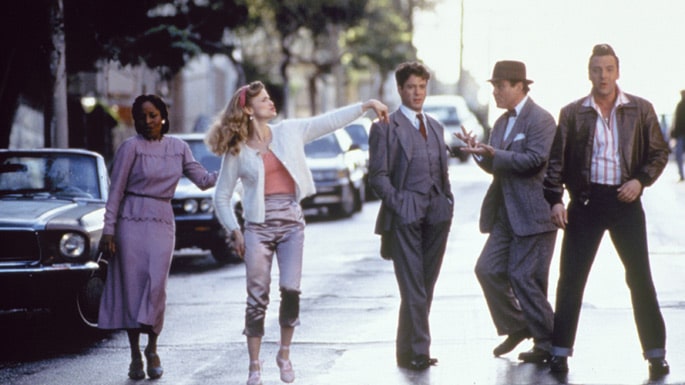
Dirty Girl is a 2010 coming-of-age
dramedy written and directed by Abe Sylvia. The film stars Juno Temple, Jeremy
Dozier, Milla Jovovich, Dwight Yoakam, and Mary Steenburgen, with cameos by
William H. Macy and Tim McGraw. Sylvia
based this fictional film on his own experiences as a teen boy in 1980s Oklahoma.
The film
centers on two teenagers in 1987 Oklahoma who are outcasts: Danielle (Temple),
a troubled and promiscuous teen girl who never knew her father, has a strained
relationship with her nosy mother (Jovovich), and hates her mother’s Mormon fiancé
(Macy), who is controlling and abusive in his methods to force his religion and
rules on Danielle; and Clarke (Dozier), an overweight gay teen boy who is shy
at school, is pressured to act straight by his homophobic father (Yoakam), is
close to his sympathetic mother (Steenburgen) and secretly loves pop stars like
Pat Benetar, Debbie Harry, and Melissa Manchester. The two meet in a high
school class for “slow” students, and are partnered together in a class project
where they are “married” and have to take care of a bag of flour as their “child.”
They bond over their social weirdness and find kinship with one another, and,
when both have had enough of the pressure from their families to conform, steal
Jeremy’s dad’s car and hit the road to find Danielle’s absentee father in
Fresno, CA.
The film
is carried by two talented and spirited performances by Temple and Dozier. Both
infuse their characters with a sympathetic air and a humor that cuts through a
lot of the angst that they are going through. Dozier excelled at playing
Clarke, a kid who is more self-assured around Danielle than anyone else, and
gains the courage to be gay and unapologetic for it. And Temple shined in this
role, making Danielle caring and kind underneath her bad-girl exterior,
bringing out both vulnerability and a devil-may-care attitude that made her an
awesome person. Temple, in particular, is a very talented and charismatic
actress who has been great in indie films like Cracks and The Brass Teapot,
despite the mixed to negative reviews of some of her films, and has developed a
stellar career in the indie film world while being overlooked in the mainstream
media.
The
supporting cast give admirable performances, but the film centers on the two
teen characters. The story is creative and interesting, as a coming-of-age road
trip movie starring two high school outcasts who shake off the confines of
their environment and find their identities. It also has a great soundtrack of
80’s women-led pop songs, opening beautifully with Pat Benetar’s “Shadows of
the Night”; Bow Wow Wow’s “I Want Candy” over Clarke dancing in his room; Joan
Jett’s “Do You Want to Touch Me” as Danielle struts across school, and Sheena
Easton’s “Strut” in a roadside bar scene. The film was charming and likable,
and was quite better than the initial title and image, which give a raunchy
idea of what the movie would be about. It is streaming on Netflix, and I
definitely recommend it, as well as Temple’s other indie films (more notably The Brass Teapot and Cracks).
Darkman is a 1990 superhero film
directed and co-written by Sam Raimi. It stars Liam Neeson, Frances McDormand,
Larry Drake, and Colin Friels. It is a tribute to 1930s Universal horror films,
and was made after Sam Raimi was turned down as a director for The Shadow movie.
The film
is about a scientist named Peyton Westlake (Neeson) who is nearly killed by
crime boss Robert G. Durant (Drake) and corrupt developer Louis Strack, Jr. (Friels)
through being tortured and left for dead in a science lab explosion, but
survives. He was being targeted because his girlfriend, attorney Julie Hastings
(McDormand), had a memo that implicated her developer boss in dirty zoning
deals with crime syndicates, and the memo was in his lab. However, his face and
hands are burned off, and the doctors gave him a special treatment that
involved severing his nerves, which left him with an inability to feel pain,
but heightened emotions due to adrenal overload, which, when he becomes highly
emotional, he has enhanced strength.
Westlake
had been trying to develop a synthetic skin to replace burnt or damaged skin,
but the skin was photosensitive and kept melting in the light. He figured out a
way to keep the skin intact for 99 minutes in the light, and that the skin
could survive in the dark. After his near-death, he develops skin through 3-D
printing and makes a replica of his original face, as well as the faces of his
killers, in order to seek vengeance. He
poses as the gangsters often to either kill them or trick them into killing
each other. While he is successful at
seeking justice, he is frequently set back by the mask time limits and his
struggles with his scientific experiments.
The film
is a dark and sad story, more along the lines of The Phantom of the Opera and House
of Wax, as well as The Crow
graphic novel, than a triumphant superhero story. It is rare to see a superhero
story that is an original character, and not adapted from a comic book/graphic
novel. Darkman was very successful,
both on a box office level and a cult following level, and spawned two sequels:
Darkman II: The Return of Durant, and
Darkman III: Die Darkman Die.
Liam
Neeson delivers an honest and sympathetic performance as Westlak, the caring scientist
whose life is destroyed by Durant and Strack, and who becomes Darkman in his
quest for vengeance. While he doesn’t feel remorse over killing Durant’s henchmen,
he often feels sadness and anger over losing Julie, his livelihood, and being
reduced to a monstrous face wrapped up in bandages. Some of the saddest scenes
in the film are when Peyton is alone in his makeshift lab in an abandoned
building, screaming and crying, unable to control his emotion levels. Even if
he defeats the villains and Julie accepts him, he’ll never have his life back,
always changing masks 99 minutes at a time.
Frances
McDormand delivers a strong and measured performance, albeit in a role that is
mostly reduced to being the girlfriend. Julie is intelligent and strong-willed,
and is an intellectual match for Peyton. She isn’t a victim or a damsel, and
investigates into the background surrounding Peyton’s supposed death.
Larry
Drake is fantastic as Durant. He brings the right kind of menace and humor to
this role, and gives a lot of character to this role. It is clear that Drake is
enjoying playing Durant, and it is one of his best performances ever.
Colin
Friel was excellent as Strack, playing a sleazy and slimeball yuppie prick. He
is so without morals that, just a few days after Peyton’s supposed death, he’s
already putting the moves on Julie, a still-grieving girlfriend. He is low and despicable,
but a great villain in this film.
Danny
Elfman did the music score, and it is epic and beautiful. Like I previously
stated in my review of Nightbreed,
Elfman can take his Batman score and
re-work it to sound strong, dark, and exciting for any low-budget sci-fi or
horror film to have. His talent is a gift that elevates any film because of his
magnificent score.
Sam
Raimi has a talent for making films that have relatable, interesting
characters; great action sequences (a sequence involving a helicopter is
phenomenal); dark humor, and a sci-fi or horror brent. His films feels unique
and special, a creative touch that is of his own style.
Darkman is an excellent film. It is sad
and epic and powerful, is a standout in the genre of superhero films and is a wonderful
tribute to the Universal horror films that were so beloved to Raimi’s
childhood.
Heart and Souls is a 1993 fantasy-comedy
directed by Ron Underwood (Tremors, City Slickers). The film stars Robert Downey,
Jr., Kyra Sedgwick, Alfre Woodward, Charles Grodin, Tom Sizemore, and Elisabeth
Shue. The film is about four ghosts who are the guardian angels of one living
man, and they use him to help them complete their unfinished business in order
to ascend to heaven. It is one of my favorite films of all time, because it is
a really positive and happy movie about second chances and making the most out
of life.
Four
people die in a bus crash in 1959 San Francisco, and become the guardian angels
to a baby boy named Thomas, who was born at the same time they died. They can be
seen only by him. Seven years later, when Thomas’ parents worry about him
talking to his “imaginary friends” and consider having him committed to a
mental institution, the ghosts decide to make themselves invisible to Thomas in
order to protect him.
Nearly
35 years later, Thomas has forgotten about the ghosts, and has become a
high-powered yuppie jerk, only caring about money and status. He is selfish and
thoughtless, and keeps his girlfriend at arm’s length, fearing commitment with
her. The ghosts, who have been with him all of his life, find out from the
ghost of the bus driver that caused the accident that they were supposed to use
Thomas’ body in order to resolve their problems from their lives, which would
allow them to leave limbo and go to heaven. When they reveal themselves to
Thomas and explain their predicament, it takes a lot of convincing on their
part to get him to agree to this arrangement in order to free their souls.
Robert
Downey, Jr. showed a lot of talent for physical comedy, taking on the
personality, voice, and mannerisms of each ghost. It showed a lot of
versatility in his talent as an actor, and is an underrated performance from
him.
The
performances from the cast playing the ghosts really make this film special, as
they put a lot of personality and character into four ordinary people from
different walks of life. Milo (Tom Sizemore) is a thief who stole petty things
for rich people, and his lowest moment came before his death, when he stole
rare stamps from a ten-year old boy. He regretted it, and uses Thomas to get
them back. Harrison (Charles Grodin) was an opera singer with stage fright, who
quit an audition due to his fears, and uses Thomas to get over his fear of
singing before an audience. Penny (Alfre Woodward) was a single mother of three
who worked the night shift as a telephone operator, and wanted to find her
kids, who were split up in foster homes and adoptive families after her death.
She uses Thomas to investigate about their whereabouts. And Julia (Kyra
Sedgwick), like Thomas, kept her boyfriend at arm’s length and pushed away his
marriage proposals until it was too late, and wants to search for him to
deliver a message of love.
One of
the best scenes in the film is due to Alfre Woodward’s performance, where she
finds her long-lost son. Her happiness and joy is absolutely infectious, and
she fills the scene with so much spirit and elation of a mother being reunited
with her son. It is a very charming performance from her, taking what could be
an overly sentimental scene and making it touching.
The film
is very enjoyable, and is a light movie that mixes in fantasy and comedy, and
is an unusual premise for a family-friendly movie. It was a modest success when
it came out, but I recommend it as a sweet and funny film.
Jack's Back is a 1988 crime thriller directed by Rowdy Herrington (Road House, Striking Distance) starring James Spader and Cynthia Gibb. Spader performs a dual role as identical twins John and Rick Wesford. The film is about a copycat serial killer imitating Jack the Ripper's murders on the centennial of his murders, killing prostitutes in the Los Angeles area. John Wesford is a nice and idealistic med student who is concerned about the welfare of the city and of his patients at the clinic where he works, much to the jaded dismay of his superiors.. A prostitute gets murdered, and John is blamed for it as the prime suspect. But John then gets murdered himself, and his murder is framed as a suicide. Enter his twin brother Rick, who has visions of his brother's killer. Rick has had a juvenile crime record of gang life and breaking & entering, and wasn't close with John, yet is determined to find his killer. He has a jaded and cynical attitude, yet has a good heart underneath. Also standouts were Cynthia Gibb as the naive love interest and Robert Picardo as the oddball psychologist.
Spader showed a versatile range in his acting ability as his career was rising, playing two characters who are very distinct from one another. At this time in his career, Spader was mostly playing villains in films, and this was an opportunity for him to play two good guys, albeit one who seems untrustworthy on first impression. Roger Ebert, in his review of the film, made this astute statement: "I don’t have any statistics to prove this, but my notion is that actors who play villains early in their careers often turn out to have more interesting careers than those who always play the lead. They find more interesting places inside themselves, and they carry a hint of complexity and secretiveness even into heroic roles." He would go on to play complex characters in films like sex, lies, and videotape, Crash, Secretary, and The Blacklist.
The film itself has a sleazy, B-movie noir vibe to it, and is an engaging thriller with some surprises and solid writing and direction from Rowdy Herrington.
Chinese Puzzle is a 2013 French comedy-drama written and directed by Cédric Klapisch, and is the third
and final installment of the Spanish Apartment trilogy, after L’Auberge Espagnole and Russian Dolls. The film stars Romain
Duris, Audrey Tautou, Kelly Reilly, and Cecile de France. The film series
centered on Xavier (Duris), a writer who first met his friends while studying abroad
in Barcelona ten years ago, fell in love with both Martine (Tautou) and Wendy
(Reilly), and has now become a family man at 40 years old. This film often is
about mid-life crises, and adjusting to a new stage in life beyond youth.
Wendy tells Xavier that she is leaving him for
another man, and she takes their two children and moves from Paris to New York
City. Xavier, while not overly surprised that his wife is leaving him, is
distraught over being separated from his children, and decides to move to New
York City as well. There, he struggles as an undocumented immigrant and
newcomer to New York life. He is working on a novel for a Parisian publisher,
but in the meantime, gets a job as a messenger, lives in a small apartment
above a restaurant in Chinatown, had donated his sperm to his lesbian friend
Isabelle (de France) in Paris so she and her girlfriend can have a baby, and
gets a sham marriage to a Chinese-American woman so he can get a green card.
All of this, and he and his friends are adjusting to turning 40 years old,
accepting their age, and trying not to repeat youthful mistakes of the past.
Klapisch has a talent for making charming films about
ordinary and likable people who seem like individuals one would know in real
life, whether in Paris, New York City, Barcelona, or elsewhere. His previous
films, like Un air de famille (Family Resemblances), a comedy centered
around a family birthday dinner and all the drama and merriment that goes with
it; and Chacun
cherche son chat (When the Cat’s Away), a comedy about a Parisian woman who loses her cat
and, while searching for it, gets to know her colorful neighbors, are both
wonderful and enjoyable films about everyday people in Parisian life.
Chinese Puzzle is a witty and interesting
film about people starting their lives over again in NYC, and adjusting to a
new culture, confronting age, changes in maturity levels, and easing out of
their adolescent mindsets from their youth.